
Transcript
4,937 words · about 21 min readGenerated automatically from the audio, so it may contain errors. Tap a time to listen from there.
Let’s get our Bible now and go to the book of Psalms. Psalm number 78. Psalm number 78. Sorry, Thomas. Psalm 78, let’s begin reading in, we’ll start reading in verse number one to get the kind of the context of what we wanna see this morning.
Psalm 78 starting in verse number one. The Bible says, give ear, oh my people, to my law. Incline your ears to the words of my mouth. I will open my mouth in a parable. I will utter dark sayings of old, which we have heard and known and our fathers have told us, which will not hide them, we will not hide them from their children, showing to the generation to come the praises of the Lord and his strength and his wonderful works that he hath done. For he established a testimony in Jacob and appointed a law in Israel which he commanded our fathers that they should make them known to their children.
That the generation to come might know them, even the generation which should be born, who should arise and declare them to their children, that they might set their hope in God and not forget the works of God, but keep His commandments, and might not be as their fathers, a stubborn and rebellious generation, a generation that set not their heart aright and whose spirit was not steadfast with God.
Read the full transcriptShow less
Would you pray with me? Lord in heaven, we thank you for the time, Lord, to be in your word, to study what it says, and Lord, we know that we need your word to live. Man shall not live by bread alone, but by every word of God. And Lord, we especially, in regards to our family, we need your help. We need your wisdom, Lord. You said that through wisdom, a house is builded.
And Lord, we we need your wisdom to build our houses in a way that is that is godly, that pleases you, that will glorify you. Lord, we are we we walk as it were in the dark and we depend upon your light to shine on our way. I pray that you’d help each and every person here. As we look in your word, I pray that your message, the burden of the Lord would be clear and known to all of us here and help me, Lord, as I try to explain the scriptures and and carry this message to your people. Lord, may they receive it. May I say just exactly what you’d have me to say, nothing more, nothing less, Lord.
Because Lord, we we trust in you. We depend upon you. And I pray especially that the name of Christ would be glorified. In Jesus name, amen. Now, as you can see in verse number three and verse number four, there’s this principle which spans the scripture of this idea that one generation who knows god and knows god’s works and knows god’s word is then supposed to take that knowledge of God and His word and then carry it on to the next generation. And the most obvious kind of go to passage of scripture where we see that is in Deuteronomy chapter six. In fact, last year, during our August Family Focus, we we had one one one Sunday where we focused on that passage and that goes back of course when the children of Israel left Egypt and god delivered them through his mighty acts out of Egypt and the Passover and walking through the Red Sea and Mount Sinai and all of those things. Those are the the that is the context of these mighty works and this law of god that he speaks to the children of Israel some forty years later and he says, remember what you saw, remember the law that I gave you, and now you tell your fan, your children, and children’s children, and pass that down.
Now, the cold truth is this, that our relationship with our wives and husbands and our relationship with our children is a is only a temporal relationship. There’s there’s no marriage as such in heaven. You know, I I know that’s true. The Bible says that directly but we assume by extension that you know, our our our moms and dads and our our siblings and our children will not will not have that same relationship to us because our those are earthly relationships as much as we cherish them and should indeed but here’s the thing, the lord did not give us those relationships even though they are temporal. He didn’t give us those relationships only for temporal things.
In fact, you see here, these are temporal relationships between the the the fathers and mothers and their children and and but they’re supposed to use that relationship to bring forth eternal fruit by means of god’s word being passed to the next generation. So, we use that relationship to bring forth fruit that that is more than temporal, that is eternal and so, and and that leads us to this conclusion which is our marriage, our marriages, our our relationships with our kids, it they’re not just about the our own satisfaction.
Although, we get a great deal of satisfaction from them and should and that’s right and that’s proper but there’s a greater purpose for our marriage and for our our children and our grandchildren. And that greater purpose is that we have the opportunity to affect the for the gospel, this world, by means of what we pass on to our children.
And this is the purpose. Our we the, you know, the Bible says that we, our life is hid with Christ in god. We exist for him, for eternal things. We should set our affection on things above, not on things on the earth and again, we’re having this whole month. We’re focusing on the family which is a thing of the earth. There’s no there’s no question about that but does it not have direct connections to heavenly things? It absolutely does.
It absolutely does which is why we need to we need to we need to set our affection on the parts of that especially that have those connections to eternal things.
And that’s what we want to do here this morning in Psalm 78. Notice verse number five says, for he established a testimony in Jacob and appointed a law in Israel that which he commanded our fathers that they should make them known to their children that the children to come might know them, even the children which should be born, who should arise and declare to them their children. Now, there are some, did you know there there even among us, even right now, there are children that are to be born. As I read this, there are some that are to be born. Joanna’s got and and Andrew, they have a baby that is to be born, hopefully soon.
And Martha has a baby and Josh have a baby that is to be born. But you know, there are some beyond that that we don’t even know about. Haven’t even, they’re not even conceived yet. That are to be born. So, what we’re reading here has application not only to you and and me here and now, but it has application to to a great deal in the future too.
Now, notice verse seven, and this is where we wanna wanna stop and examine a little bit. So, the Lord tells them in verses three, four, five, and six, he says, listen, I gave you a law, I did these great works, now I want you to take these commandments and these laws and my word, and I want you to give them to your children.
Verse seven and eight provides us with the reason he wants us. He wanted Israel and then of course us as well because this is an idea that’s repeated in the New Testament. Fathers, provoke not your children to wrath but bring them up in the nurture and admonition of the Lord. That is this summarized. It’s the same truth.
But verse seven and eight give us the reasons that the Lord tells us to do these things. It describes to us the end or the goal of a parent instructing and teaching his or her child. In other words, we know god has instructed us to teach our children but why? What is what should be our goal? What should be the end? Is it just listen? Is it just that we instruct our our children so that they will not embarrass us?
Are we, do we teach our kids the things of god and the right way to live because we we just we want them to have a successful life. What is a successful life? If your child or my child, you know, they they go to school and they get a, you know, a degree or they become this or that, a lawyer, a doctor, or whatever. They become a CEO of a company and they make millions of dollars and and they have kids and everything’s great, you know, as far as on the in the temporal world, but is it success if in that process, the Lord Jesus Christ, they do not seek him first? Is that success? Or is it success if they accomplish all these things in this world that would be considered success, but there’s a question mark surrounding where they stand with God, whether they’re actually saved.
Is that success? You see, this is what I’m talking about. This is where the rubber meets the road between the temporal relationship and the eternal. Because the truth is the temporal exists for the eternal.
And this is why these words are so important. The Lord tells us what is the goal in verse seven and eight. What are we trying to accomplish? Here’s the goal. Verse seven says this, that, our children now, that they might set their hope in God, that’s number one, and number two, not forget the works of god. Number two, but keep his commandments. Number three, and on the negative, verse eight, and might not be as their fathers.
Number four, and under that, under number four, you have what are what it what what is the description of the fathers? Here it is, stubborn and rebellious, hearts not set aright, spirits not steadfast with God. That’s it.
So looking at each one of the these in turn, look at look if you would at verse number seven, that they what is the goal of teaching our children God’s ways, God’s truth? Number one, that they might set their hope in God. You know what this is? This is faith. Yes. Hope, hope in scripture, those of you in Sunday school, you know this. Hope is faith in the future aspect.
Faith regarding something not yet done. So, faith is in this word. That they might set their hope in God. You see, our purpose in teaching our kids God’s word is not to fill their head with knowledge. It’s not to just so that they memorize bible stories. It’s not for any of those reasons only. In fact, that’s that’s not that that that’s a secondary thing entirely. The end goal of our teaching our kids the word of god is their individual personal faith in the god of the scriptures.
That’s the goal. You see that in this verse? Verse seven. You know, that’s why we do. That’s why we teach them. It’s for that purpose, not just general knowledge, not just so they’ll be spiritually spiritually educated. No. Knowledge knowledge, what what it what purpose is the knowledge of the scriptures if it does not lead to personal faith in the god of the scriptures? That’s that’s the religious world. That’s what it’s full of and that’s not that’s just not good enough.
Our goal that the lord tells us should be, we teach our kids so that they might have personal faith in god. The second thing it says is this, and not forget the works of God. This is the knowledge of God’s works as recorded in scripture. That’s what this is. The knowledge of god’s works as recorded in scripture but I wanna pause here because I’m going somewhere with this. So, if if you’ll just hang with me, we’ll we’ll get to a conclusion. It won’t take long.
What work of god is there that is supreme to every other work of God? You can read like like you read in verse number seven and not forget the works of God. So you can talk about the Red Sea. You can talk about Noah and the flood. You could talk about the lord Jesus healing people. You could talk about many many works of god that are written in scripture. Many of them. Is it good for kids to know those things? Is it good for us to teach our kids those things? Like we teach the scriptures. Is it good that we teach? Yes.
But there’s one work of god that is supreme to them all. Does anybody know what that is? It is that that our god sent his son into the world and that son who lived a sinless and perfect life voluntarily and willingly went to a cross to bear the sins of this world, to bear the sins of you and to bear this my sins and he paid the just penalty we deserve and that same one who died and was buried in a grave rose again the third day and he did all of that for our justification that we might be made righteous before God, that we might be forgiven of our sin and made right with God. There is no work of God greater than that work. Amen. That is the greatest work. So, when you see this, listen, why should you teach your kids?
Why should you teach your kids the Bible? Because your kids and my kids need to know what is the greatest work that God has done. This is our goal of all the works of God. This should be at the top of the list. Amen. And by the way, this is not something you teach your kids once, and then you say, well, I’ve done that. That is not the way it works, not in any of this.
But let me move on. Verse seven goes on, it says, but keep his commandments. This is doing what God has commanded. How many commandments are there in scripture? There’s a bunch. There’s five thirteen, six thirteen I think it is, they count? Six fourteen. Six fourteen. They they say, I don’t know how they get that number, but they say the the Jewish Orthodox Judaism says there’s six fourteen commandments commandments in the Old Testament, in the in the, I think actually in the Torah, which is the first five books.
And then there’s all of the rest of the the Old Testament, and then there’s the New Testament. There’s a lot of commandments. What are we talking about? Are we just trying to teach our kids, well, you know, you should respect your elders, and you should say nice things, and you should not use foul language and you shouldn’t do drugs and you should stay away from liquor and all of those and all of those are true and right and I teach my kids and have taught my kids all of those things that is true and right but what is the top of them all?
When you start teaching your kids the commandments of God, what should be the first one? Here they are. Repent ye therefore and be converted, that your sins may be blotted out When the times of refreshing shall come from the presence of the lord, Acts three nineteen. Or how about Acts 17 verse 30, and the times of this ignorance god winked at but now commanded all men everywhere to repent.
Mark one fifteen, Jesus himself said, the time is fulfilled. The kingdom of god is at hand. Repent you and believe the gospel. First John three twenty three and this is his commandment. I say, this is his commandment that we should believe on the name of his son, Jesus Christ, and love one another as he gave us commandment. Isaiah, you want to go back to the Old Testament or we’ll go back to the Old Testament. Isaiah 4,522, look unto me and be saved all the ends of the earth.
For I am god and there is none else. So, we teach our kids to keep the commandments of God, but be very careful. At the top of that list is the command to believe on the Lord Jesus Christ, to put one’s personal faith and trust in him for their salvation. That is his command. Here’s the problem, if we teach our kids all of these other commandments which are all good and right in their place, and we somehow neglect this first commandment, it turns all the others into just a kind of moralism, do goodism.
Because the greatest thing they have neglected. I should say, the foremost commandment of God. You can attempt to honor your parents and that’s right, you can try your whole life to honor your parents and it will not get you to heaven. It will not get your sins forgiven, it will not make you right with God.
Only obeying the gospel of Christ will doing that, will do that, and that is repentance toward God and faith toward our Lord Jesus Christ. That is the first commandment. I should say foremost commandment that God directs toward the world, toward mankind.
We cannot, as we teach our kids, we cannot overlook or ignore this foremost commandment to mankind. Because, again, it is not just about getting our kids to behave, it’s about their soul. It’s about where they stand with God. It’s about their personal faith in Christ. And it says this, on the negative side it says that, and might not be as their fathers, and I mentioned stubborn and rebellious, their heart’s not right, spirit’s not steadfast with God.
You notice, this is again the aim, the goal for our teaching our kids the ways of God in the scripture. This is the aim. The emphasis is not on temporal things but on things that pertain to god. It says, whose spirit was not steadfast with god. That’s what happened when with their fathers who did not know anything about god. What happened is they went the way of man and the way of man is bent away from god.
So, here’s the truth. If you and I neglect to teach our kids the ways of god, the word of god, the scriptures of god, and the commandments of god. The the the foremost of which pertain to the gospel like I’ve already shown you. If we neglect that, 100%, the natural bent in our kids’ nature will lead them away from god guaranteed.
You see, it is our duty to instruct them and to teach them the things of God. Amen. Now, I want you to come with me to the New Testament to two places. I want you to go to Acts chapter one and Matthew chapter 28.
First Acts chapter one. Acts chapter one verse eight. We know this is part of the great commission, this is the the final example of the great commission. It says this, but ye shall receive power, after that the Holy Ghost has come upon you, and ye shall be witnesses unto me, both in Jerusalem and in all Judea and in Samaria and unto the uttermost part of the earth. Now, you’re familiar with this verse.
You know the great commission what what is teaching here but there is a it a principle in the great commission here that says that the gospel is supposed to radiate out from the nearest place out to the furthest place. That’s what Jerusalem, Judea, Samaria, and unto the uttermost part of the earth. You’re very, I’m sure all of you are familiar with that to some degree or another.
But let me ask you a question. To you as an individual, what place is nearer to you than your own home? And what people are nearer to you than your own children?
You see, in the great commission, there is this principle that the nearest to you are the ones that who should hear the gospel from your lips and mine. There’s no one nearer to you than your family. Amen. Than your children. So, I want to remind you that We are, as parents, our duty bound to give the gospel, to be the evangelists to our own children. You know, Psalm 78 didn’t mention the gospel directly, but it mentioned the commandments of God. It mentioned the truths of God. It mentioned faith in God. All of those things at the top of the piles, at the top of the list of each of those things is the gospel of Christ and our personal faith in it.
And those are the things we teach our children but we are duty bound to do that. The great commission also reaffirms that because it tells us that we should start in our Jerusalem. Where is your Jerusalem but your but but your living room, but your dining room table. This this is your Jerusalem and you and I as parents are duty bound. We have an obligation before god to make sure that our kids have the gospel and they know the gospel and understand the gospel and they’ve been confronted with the gospel and we are duty bound to proclaim the gospel and evangelize our children.
Look at Matthew 28. If you would, There’s another principle of the great commission I want you to see. Not only the priority, Jerusalem first, but I also want you to see what’s included in the Great Commission. Verse 19, Matthew 2eight 19 says this, go ye therefore and teach all nations, baptizing them in the name of the Father and of the Son and of the Holy Ghost, teaching them to observe all things whatsoever I have commanded you and lo, I am with you always even unto the end of the world, amen.
Now, I know this is a a broad scoped, you know, command for the church in the world over all time. I I understand that but if we take this and we apply it like we did Acts one to our family, we see that let here, now hear me. Evangelizing your children is more than just making sure they’re saved. Amen. Because the great commission is more than that, is it not?
It’s it’s teach all nations, there’s the faith part, and then it goes on with the further steps of discipleship and following Christ. First, baptism and then teaching them to observe all things whatsoever I have commanded them. And that that’s Psalm 78. All the other commandments of God. You see the order? All the other works of God. You see the order?
You see, I fear that many Christian families around here especially have taught that the only thing they need to be concerned with is that their kid prays the prayer. That is not what it’s about. First of all, there’s a lot of questions about that and the kid, listen, there are many shipwrecks in this society who prayed a prayer. Yes. Yes.
You say, man, and I I listen, those of you listen that are that are sincere, right, and you’re and you really want your children to be in heaven with you, you really want them to be right with God, listen, that’s that might scare you. Well, is what do I what do I do? What do I do? Here’s the thing. You become the evangelist for your your children.
And you don’t get them to just pray the prayer to make yourself feel better, they’re saved now. No. It’s a it’s a beginning of a long process where you deal with them on the subject of the gospel because remember, that’s the top of the list and you you preach the gospel to em over and over and over and over and you share the gospel and show them the gospel and teach em and you show them why they need the gospel and all of these things related to it and you do it again and again again and again and again again and there’ll be all kinds of questions and there’ll be all kind of confusion and doubt and and all of these things in your kids but you keep doing it and you keep doing it and you keep doing it. In other words, you fulfill the great commission to your children. Starting with the gospel and then once they know Christ, then you teach them to observe all things whatsoever Christ has commanded just like you would any a stranger.
They are nearest to us Even when our children have personally trusted in Christ for their salvation already, our work is not done. We must then disciple them. So I have a question to finish this.
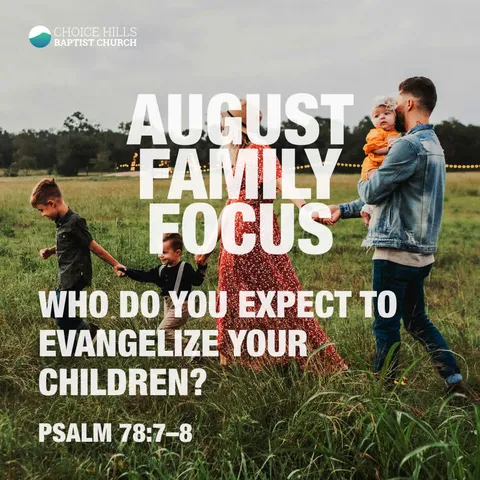
And this is the hardest part. But here’s a question I wanna pose to you. Who do you expect to evangelize your children? If you and I are not being the evangelist to our children, and if you and I are not discipling our children, who in the world is expected to?
Listen, the preacher is supposed to preach the gospel. The preacher is supposed to to preach the word of god and and we’re going to try to do that and the Sunday school teachers are supposed to preach the gospel and share the word Like sister Pam, like sister Beverly did. They’re supposed to give the word but they are not the primary ones who own the duty. Every parent in this room is duty bound to be the evangelist for your child.
It’s not other people’s duty. It’s our duty. Well, but but I wanna warn you, there’s a cheap substitute and here here it is. I told you it was gonna be kinda hard. Well, I keep him in church. That is not what we we’re talking about here. In fact, that actually that actually flows into the very problem.
Because we’re taking a duty that is ours and only ours. And we’re saying it’s other people’s job to do. It’s the church’s job to do. No, it is my job to do. Amen. It is my job to make sure that Isaiah and Mary Lynn and Charity and Josh and Abby and Anna all know the gospel through and through and through and have not only know it but they’ve been confronted, personally confronted, and examined.
Is their faith real? Do they know Christ? Is there evidence of that fact? And if so, are they growing? Do they know the scripture? Are they are they living in sin? Are they living uprightly? Listen, it is my duty as their father and it is your duty to your children. It’s not anybody else’s, it’s yours.
We get this idea from the kind of revivalism where we think we’re evangelizing because we invite people to church, and that’s fine. But that’s not evangelism. Evangelism is inviting them to Jesus and telling them what Christ has done for them.
What do your kids think when they see you bring them to church and they hear the preacher and he talks about the gospel and he talks about eternal life and he talks about forgiveness of sin and he talks about what Christ has done and all these things. What do your kids think if you bring them to church but you don’t talk about those things to them at home?
What message is that sending? You see, if we bring our children to church, and we bring our children to Sunday school, or our children go to a Christian school or maybe they’re homeschooled with a Christian curriculum but at home, with mom and dad, they do not hear their own parents explaining clearly the truths of the gospel to them personally, challenging them to examine themselves, challenging them to believe on the lord Jesus Christ personally if if if our kids do not hear that, we are answering that question implicitly.
We’re answering the question, who do we expect to evangelize our kids? We are saying, I expect somebody else to do it but it is my job. It is my job.
And if you have children, it’s yours. To tell them the works of God, to tell them what what God has done, to tell them the commandments of God, to tell them and explain to them how to have faith in God. So I just wanna ask you this, we’re not even gonna have an invitation because we’re having the Lord’s Supper.
Are you being the evangelist for your children? Are you the missionary to your family? Have your kids been confronted, persistently, faithfully, repeatedly with the truths of the Gospel and with the response needed to the Gospel from mom and from dad?
Let’s pray together.